

A lot of people finish high school and get the same advice:
“Just apply everywhere.”
I understand why people say it. It sounds like more applications should mean more chances.
But the more time I spend with young job seekers at my Caly Cares workshops, the more I think applying everywhere is part of the problem. People find jobs they like and still get stuck. Do I qualify? Which resume should I send? Is this job even worth it?
I’m still a high school senior myself, so I’m not writing this as someone who has everything figured out. I’m writing it because those same questions keep coming up, and I think there’s a simpler way to start.
Start with what you need from a job
Before you search, answer three questions:
- When can you work? Think about school, family, another job, or anything else on your schedule.
- How will you get there? A job you can reach by bus, by walking, or with a reliable ride is worth more than a better one you can’t get to.
- What do you want this job to do for you? Money right now? Experience in a field you’re curious about? A path into training?
There’s no wrong answer. But your answers change where you should look.
Where entry-level jobs actually are
Many places hire people with no experience and train them on the job. A few to look at:
- Places you already go. Grocery stores, restaurants, retail stores, movie theaters and gyms.
- Hospitals, clinics and senior-living communities. Front desk, food service and support roles. Some have age minimums, so read the posting.
- Warehouses and delivery.
- Banks and credit unions. Some teller roles are open to recent high school graduates.
- Your city or county. Parks, libraries and recreation centers often post part-time jobs on their own websites.
- Apprenticeships and trade programs. Some let you earn while you learn a skilled trade.
You don’t have to do this alone, either. Youth programs and public libraries help people find and apply for jobs. Here in San Antonio, I’ve held workshops with SA Youth, and most cities have programs and libraries like that.
One tip: when you find a job on a big job site, check the company’s own careers page too. Listings can stay up long after a job is filled, and the company’s page is usually the most current.
Read the posting before you apply
This is the step people skip the most.
Before you start an application, look for:
- Age minimums, like “must be 18 or older”
- Availability, like “weekends required” or “open to close”
- Physical requirements, like lifting or standing for a full shift
- Certifications, like a food handler card
- Hours, whether it’s part-time or full-time
If you clearly don’t meet a hard requirement, it’s okay to move on. If you meet most of what the posting asks for, apply anyway. Postings often describe the perfect candidate, and real people get hired without matching every line.
One job. One resume. One application.
This is the idea my Caly Cares workshops are built around.
Instead of sending the same resume to twenty places, pick one job that fits you. Change your resume so it matches that job. Then actually finish the application.
At the workshops, participants work on a real opportunity, tailor their resume and aim to submit the application before they leave. Across my first two workshops at SA Youth, participants submitted 31 job applications. At the second one, every participant applied for a job.
Then you do it again for the next job.
It feels slower at first. But every application you send is one you would actually want to hear back from.
Your resume isn’t as empty as you think
A lot of people think they have nothing to put on a resume. Usually that isn’t true.
Think about school projects, clubs, sports, volunteering, babysitting, taking care of younger siblings, or helping out at a family business. If you’ve ever run a small business of your own, that counts too. Mine was selling cupcakes.
All of those can show things employers care about, like showing up on time, handling money, talking to people and finishing what you start.
After you apply
- Write it down. Keep track of where you applied and when.
- Follow up. If you haven’t heard anything in about a week, a short, polite message is fine.
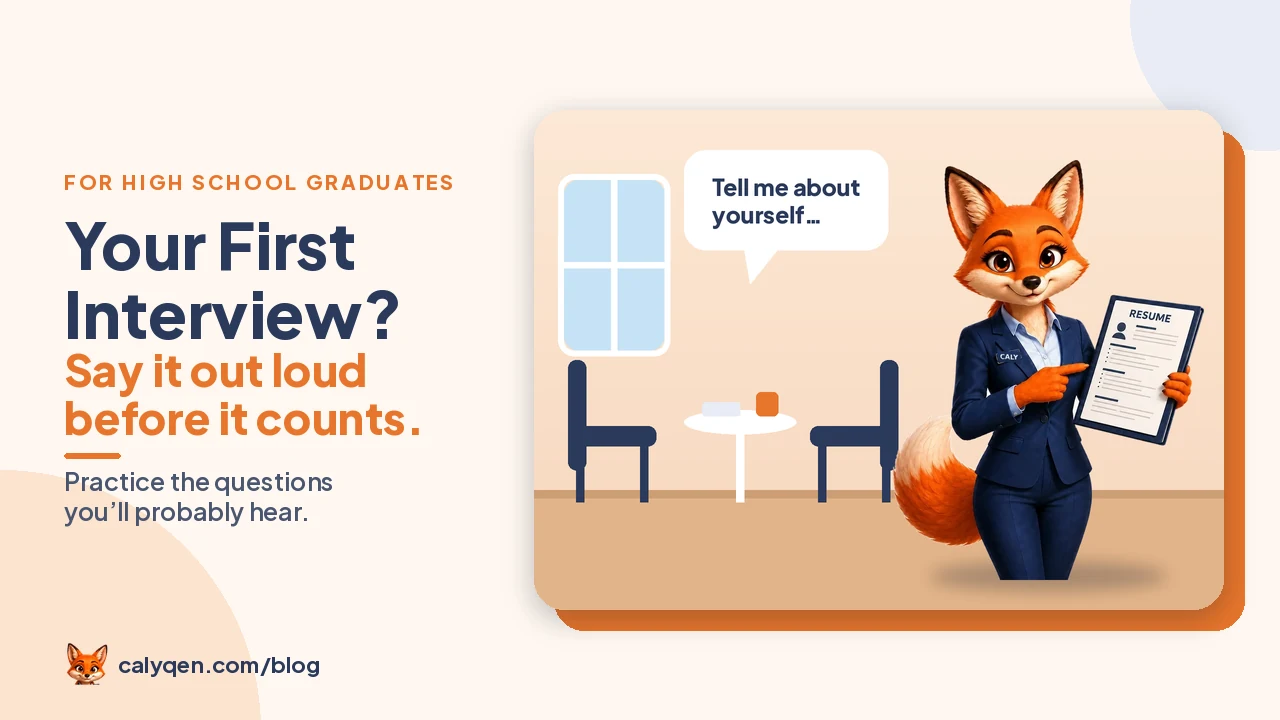
- Practice out loud. Before any interview, say your answer to “Tell me about yourself” out loud a few times. The real interview shouldn’t be the first time you hear yourself say it.
Where Caly fits
I started Calyqen after watching my mom go through a hard job search. I kept thinking it shouldn’t be this confusing.
For high school graduates, Caly helps you build a resume from your skills and activities, find entry-level and part-time jobs that fit you, practice interviews, and keep track of your applications in one place. You approve every edit, and it’s free to start.
Sign up free and start with one job.
Because I don’t think the goal is to apply everywhere.
I think the goal is to find the right next step and actually take it.